





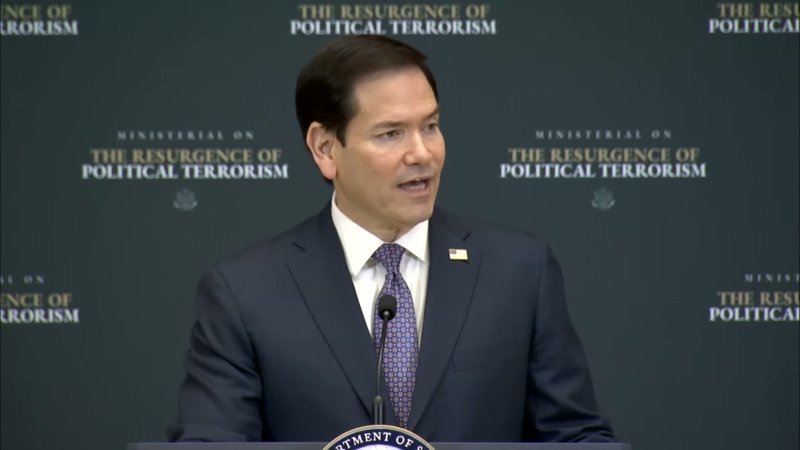
On July 16, 2026, Marco Rubio gave perhaps the most important speech of his tenure as Secretary of State when he spoke to the Ministerial on the Resurgence of Political Terrorism. In it, he told the assembled intelligence and law enforcement leaders from over 60 nations what many people have known for years: that left-wing political violence is surging, at levels not seen in decades.
After Rubio reminded his audience about the numerous Soviet-inspired terror organizations responsible for most non-state political violence in the West in the 1970s, he proclaimed that, "today, we face a new wave of this old evil. Here in the United States, the share of left-wing terrorist attacks and plots has risen to levels not seen in decades."
Rubio didn't cite David C. Rapoport in his speech, but he was using the language that the late UCLA political science professor made famous.
First published in 1999 under the heading "Terrorism" in the Encyclopedia of Violence, Peace and Conflict, Rapoport introduced the world to the wave model that would come to dominate the academic discourse on terrorism. His largely-overlooked essay acquired new relevance after 9/11, and he quickly published "The Fourth Wave: September 11 in the History of Terrorism" in December 2001, followed by an expanded and updated version in 2004, under the title "The Four Waves of Modern Terrorism."
The wave model soon became canonical in terrorism studies, and the seminal study grew larger and more thorough over the years, culminating in a book titled Waves of Global Terrorism: From 1879 to the Present published in 2022, two years before Rapoport's death at age 95.
The Wave Model
Rapoport divided modern international terrorism historically into four distinct periods, each named for the dominant ideology motivating the violence. Rather than calling them "periods," "eras," or the like, he chose a metaphor to provide flexibility to his model and to indicate each period's wave-like "cycle of expansion and contraction phases." He focused only on big waves, terrorism with an "international character ... [where] similar activities occur in several countries, driven by a predominant energy that shapes the participating groups' characteristics and mutual relationships." Rapoport named each wave for that energy and provided dates:
- Anarchist Wave, 1879-1920s
- Anticolonial Wave, 1919-1960s
- New Left Wave, 1960s-1990s
- Religious Wave, 1979-2020s?
The names are accurate enough, though one might quibble with calling the Fourth Wave the "Religious Wave" instead of the "Islamist Wave" since, as Rapoport puts it, "Islam is at the heart of the Fourth Wave." The dates reflect how difficult, sometimes impossible, it is to determine precisely when a wave begins and ends. Three dates, however, stand out: 1879, 1919, and 1979. The Russian terrorist group Narodnaya Volya ("People's Will"), which eventually assassinated Tzar Alexander II, was founded in 1879, marking the onset of the Anarchist Wave. The Treaty of Versailles was signed in 1919, marking the beginning of the Anticolonial Wave. And 1979, a tumultuous year that began with the Iranian Revolution and ended with the Soviet invasion of Afghanistan, marks the beginning of the Religious Wave.
In the 2004 version, Rapoport noted that "the fourth wave may last longer than its predecessors," but added, "If history repeats itself, the fourth wave will be over in two decades."
Academia Sees a Right-Wing Fifth Wave
After George W. Bush's presidency ended, Barack Obama sought to end the "Global War on Terrorism" and shift attention away from jihadi groups. He infamously minimized ISIS, insisting it "is not 'Islamic'" and "is certainly not a state," and called it "the JV team" as he exaggerated the threats of right-wing terrorism. His administration popularized the euphemism "violent extremism" and purged references to jihad and Islamism from federal discourse.
Donald Trump tried to reverse Obama's course in his first presidency by taking aim at ISIS, but the media, academia, and even some elements of the Intelligence Community remained obsessed with right-wing violence.
Soon it was widely argued throughout academia that a Fifth Wave of terrorism would come from, or was already evident in, the Right.
In 2020, the journal Perspectives on Terrorism published "Right-Wing Terror: A Fifth Global Wave?" by Vincent A. Auger; in 2021, it published "A New Wave of Terrorism? A Comparative Analysis of the Rise of Far-Right Terrorism" by Jonathan Collins. That same year, the journal Terrorism and Political Violence published "Right-Wing Waves: Applying the Four Waves Theory to Transnational and Transhistorical Right-Wing Threat Trends" by Amber Hart. Many others followed the trend.
Unfortunately for his legacy, even Rapoport jumped on the bandwagon.
His book's concluding chapter, titled "The Fifth Wave?", insinuates that "the explosion of far-right terror in the West" might be part of an emerging Fifth Wave. It disappointingly repeats many left-wing bromides, cites the SPLC and Joe Biden as reliable sources, and insists that Antifa is "not the left-wing body Trump described" but rather "a movement of autonomous groups aiming to achieve their objectives through demonstrations largely inspired by reactions to far-right groups." At least he didn't repeat former FBI Director Christopher Wray's infamous description of Antifa as "more of an ideology or a movement than an organization."
Rubio Suggests a New Wave
In his July speech, Rubio recounted U.S. success fighting Fourth Wave groups: "we destroyed the ISIS Caliphate; we killed al-Baghdadi, and al-Zawahiri, and bin Laden. And we built intelligence and law enforcement systems capable of anticipating and stopping attacks before the public even hears about them." But he stopped short of announcing that the Fourth Wave is over, acknowledging that while "the threat has not disappeared ... [it] has been severely diminished."
Instead, Rubio focused on the Third Wave, likening today's atmosphere to the era when the American Weather Underground, the Italian Red Brigades, the German Red Army Faction, the Japanese Red Army, the Greek November 17 Organization, the Peruvian Shining Path, the French Action Directe, and others terrorized the world. "Between 1970 and 1980," Rubio said, "93 percent of terrorist attacks in the West came from the far extremist left."
He suggested that the new wave was a reiteration of this old one. "It may wear various different slogans and ideologies across place and time," he said, but "[i]t is always the same."
But the Fifth Wave is more than merely a reenactment of the Third Wave. And it is more than a fusion of the Third and Fourth Waves as the "Red-Green Alliance" rhetoric would suggest.
The Fifth Wave is in fact an amalgamation of all four waves, under a left-wing umbrella. Perhaps we should call it the New, New Left Wave.
Like the First Wave, it has strong anarchist and anti-capitalist elements. Rapoport calls the First Wave "The Golden Age of Assassination," and indeed assassination is back in the Fifth Wave with multiple assassination attempts against candidate and then President Donald Trump. Before that came the shooting of Republican members of Congress at a baseball practice and the attempted assassination of Supreme Court Justice Brett Kavanaugh. Then came the assassination of UnitedHealthcare CEO Brian Thompson and the glorification of his anarchist-leftist assassin. Then came the assassination of conservative media star Charlie Kirk.
Like the Second Wave, the Fifth Wave is anti-colonial, but it goes even further. Today's terrorists are not only anti-colonial but postcolonial. Their goal of "decolonizing" the world means destroying anything they consider to be a colonial power – including the U.S., which the Left derogatorily refers to as "Turtle Island."
Like the Third Wave, the Fifth Wave is motivated by a leftist ideology, and, also like the Third Wave, it primarily targets Americans.
Since the Fourth Wave has yet to end, Islamism still plays a significant role in the Fifth Wave.
The Fifth Wave of terrorism is anti-Zionist, antisemitic, anti-law enforcement, anti-capitalist, anti-conservative, anti-Republican, and anti-Trump. Everything that its adherents favor is defined by what they oppose. Their environmentalism is defined by their anti-industrialism. Their Marxism-Leninism is predicated on their disdain for capitalism. And their Palestinian advocacy, including support for the PLO, Hamas, and Hezbollah, is defined by their hatred of Israel.
Tomorrow: "Part 2: Governmental Support"
 Chief IPT Political Correspondent A.J. Caschetta is a principal lecturer at the Rochester Institute of Technology and a fellow at Campus Watch, a project of the Middle East Forum where he is also a Milstein fellow.
Copyright © 2026. Investigative Project on Terrorism. All rights reserved.
Articles by the IPT may be re-published as long as full attribution and a link back to the original article is provided. |