





In spite of its agreement with the Trump administration and its promise to combat antisemitism on campus, Columbia University is preparing to hire yet another credentialed, Israel-hating, BDS activist for a very high-profile job. Doing so should be enough for the Trump administration to consider all past agreements null and void, having been negotiated in bad faith, and follow through with its threat to withhold all federal funding until a new administration appears that is serious about addressing Columbia's antisemitism problem.
The Edward Said Professorship
On February 9, Jessica Schwalb at The Washington Free Beacon broke the story that Columbia had narrowed down its list of candidates for the Edward Said Professorship in Modern Arab Studies and Literature to three very bad choices. Two days later, Maya Sulkin at The Free Press identified a fourth bad candidate.
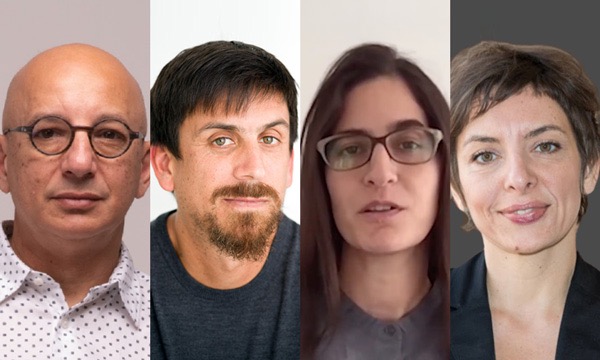
Each of the four finalists for the position – Khaled Fahmy, Max Weiss, Rosie Bsheer, and Sherene Seikaly – are history professors known for their anti-Israel activism, including encouraging student protests and encampments, exactly the problem Columbia claims it is trying to redress.
Historian Khaled Fahmy, identified on his Tufts University page as "Professor, Studies in Race, Colonialism, and Diaspora," believes that Israel is guilty of "war crimes, occupation, ethnic cleansing, and genocide." He supported the anti-Israel protests and encampments, according to a letter he signed in 2024.
Max Weiss, professor of history at Princeton University, is fond of referring to the "genocidal Israeli war machine" and accusing Israel of inventing "false narratives" about "Hamas using civilian institutions and infrastructure as bases for armaments and training facilities." He was also an active member of the Princeton University Spring 2024 "Gaza encampment" and was placed on probation by the university for "unprofessional" and "coercive" behavior. In 2014, he was one of five Princeton professors who circulated a petition demanding Princeton divest from Israel and was photographed at a protest holding a sign that read "Another Jew Ashamed of Israel's Insatiable War Machine."
Rosie Bsheer was let go from Harvard where she was assistant professor of history and associate director of the Center for Middle Eastern Studies. She was a vocal advocate of the Harvard students who were first to blame Israel for October 7. She supported their "Gaza encampment" in the Spring 2024 semester and urged the administration to negotiate with its anti-Israel students. According to Jonas Du at The Free Press, "a March 9 message that has not previously been reported" has her in the lead after having been "unanimously and enthusiastically" recommended by the hiring committee. Assuming that's accurate, as Du reports, she now must undergo a "rigorous vetting process" that includes "multiple additional levels of review."
Perhaps the most dangerous of the four finalists for the position is Sherene Seikaly, another professor of history at the University of California, Santa Barbara. Seikaly heads the steering committee of the Faculty for Justice in Palestine, which is worse than the Students for Justice in Palestine. Not only is she a Hamas supporter and an Israel hater who will exacerbate, not alleviate, the antisemitism among Columbia's students, but she will also do everything in her power to encourage the faculty to join her at the forefront of "the resistance."
Columbia took one step forward by permanently banning Students for Justice in Palestine (SJP). If it hires Seikaly, the driving force behind the Faculty for Justice in Palestine, it will take several steps backwards. Given Columbia's record, I expect Seikaly will get the job, in spite of the search committee's apparent endorsement of Bsheer.
None of these four candidates will do anything to alleviate Columbia's antisemitism problem.
Post-October 7 Scrutiny
From the moment Joseph Massad, Columbia's repugnant professor of modern Arab politics and intellectual history, celebrated October 7 as a "striking," "awesome," and "innovative" act of "resistance," the Ivy League school's reputation has been in a tail spin. Failure to control its Hamas-friendly faculty and student body led to a mountain of bad publicity, unprecedented public scrutiny, and a series of toppled administrations, beginning with president Minouche Shafiq's resignation in 2024.
After the Trump administration threatened to withhold federal funding and place the school in receivership, Columbia's new president Katrina Armstrong acknowledged the school's problems in March 2025, and promised to conduct a "thorough review of the portfolio of programs in regional areas across the university, starting immediately with the Middle East." She appointed Miguel Urquiola, senior vice provost for academic initiatives, to supervise the review and resigned shortly after the announcement.
In July 2025, yet another new president, ABC's former Good Morning America journalist Claire Shipman, announced that Columbia had reached an agreement with the Trump administration that would address "the very serious and painful challenges our institution has faced with antisemitism." She also acknowledged that "there is still more to do" at Columbia to "combat antisemitism."
Last month, Urquiola released his Initial Recommendations from the "thorough review" Armstrong initiated. His report refers to the ongoing search to fill the Said Professorship as part of Columbia's effort to "add variety and expertise to the curriculum." The candidates it is considering will do neither.
Social Sciences to the Rescue?
Urquiola's recommendations suggest that social scientists will counter the antisemitism evident among Middle East studies faculty. The history department is conducting the search for the new Said Professor, and the economics, political science, and history departments figure prominently in Urquiola's recommendations. This approach views Columbia's antisemitism problem as solely a Middle East studies problem when, in fact, it is much more widespread.
Still, some may find comfort in Urquiola's promise to "expand coursework on the Middle East broadly, particularly within the social sciences." Others may be reassured by the promises to hire "a professor to teach about the history of modern Israel," "a professor to teach courses on the Jewish world and on Middle East policy," and "a visitor to teach about economic and other policy issues in Israel."
But if political scientists, economists, and historians are the answer to Columbia's antisemitism problem, it will depend on which political scientists, economists, and historians it hires. Here, Columbia's history is not a good one.
Political scientist Mohamed Abdou, who taught at Columbia in 2024, participated in the "Gaza encampment" on campus and celebrated October 7 with a Facebook post proclaiming "I'm with the muqawamah (the resistance) be it Hamas and Hezbollah and Islamic Jihad."
Economist Jeffrey Sachs, who writes for Al-Jazeera, makes videos for The Middle East Eye, and spreads the calumny that Israel is committing genocide, is not only a full professor at Columbia but also the director of its Center for Sustainable Development. Urquiola is a member of the economics department, so he is surely aware of his colleague's views.
As for the history department, it was home to former PLO spokesman Rashid Khalidi who retired last year, vacating the very Edward Said Professorship Columbia is poised to fill with another historian like him. Also, since the history department is conducting the search for the new Edward Said Professor, it is presumably responsible for choosing the terrible candidates Columbia is considering to replace Khalidi.
The Rationale
So why has Columbia chosen to hire another known Israel-hater after signing an agreement committing the university to address its antisemitism problem?
One possibility is that the newest president, senior provost, and the rest of the decision makers are earnest in their motives but completely unaware that their top candidates will only make matters worse. If so, if Columbia's leaders really don't know what they are doing, the Ivy League school is a lost cause, doomed to repeat its mistakes and drag its reputation through the gutter.
Another possibility, however, is that Columbia's leaders know exactly what they are doing and want to spite the Trump administration, the Department of Education, the House Committee on Education and the Workforce, and every other critic of Columbia's Hamas-friendly, antisemitic culture. If so, if they are deliberately sticking their thumb in the eyes of Columbia's many critics, then Urquiola's report is window-dressing, designed to appear as a solution to the university's antisemitism while preserving the status quo.
Conclusion
For the entire 21st century, Columbia University has been ground zero of academia's anti-Israel problem. Martin Kramer first exposed "malpractice" in the Department of Middle East and Asian Languages and Cultures in 2002. In 2005, after the documentary Columbia Unbecoming showed just how bad the situation had become, Kramer called it "Columbia University's Darkest Hour." Since October 7, it has gotten darker.
Perhaps in July, when Jennifer L. Mnookin becomes Columbia's fourth president since October 7, her administration will bring light back to the once-great university. Until then, Columbia's motto, In Lumine Tuo Videbimus Lumen ("In your light we see the light") is a farce.
 Chief IPT Political Correspondent A.J. Caschetta is a principal lecturer at the Rochester Institute of Technology and a fellow at Campus Watch, a project of the Middle East Forum where he is also a Milstein fellow.
Copyright © 2026. Investigative Project on Terrorism. All rights reserved.
Articles by the IPT may be re-published as long as full attribution and a link back to the original article is provided. |
 Radical U – Part 1: How Professors Became Architects of the Academic Palestinian Resistance
 Radical U – Part 2: How Students Turned their Professors' Words into Deeds
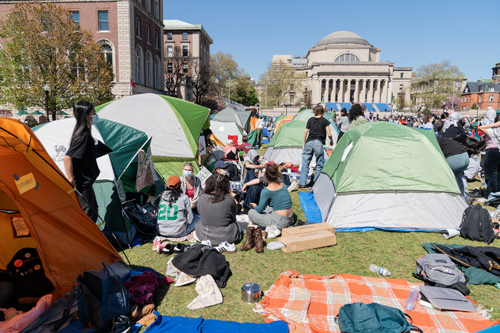 Whitewashing Anti-Israel Campus Protests