





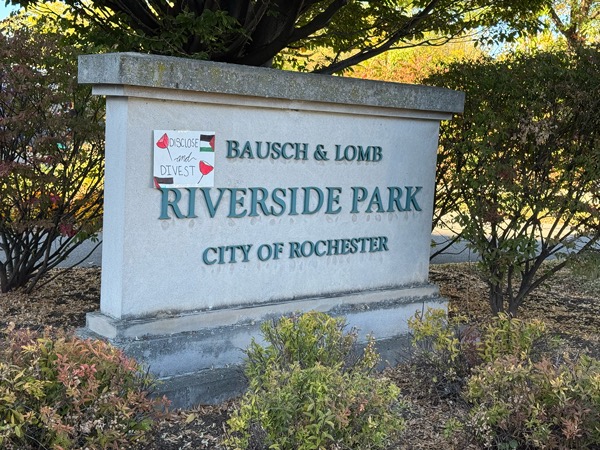
In the two years since October 7, the anti-Israel campus group known as Students for Justice in Palestine (SJP) has dwindled from a force to a farce. From occupying buildings, disrupting classes, and setting up encampments, it now resorts to hunger strikes. Not long ago, SJP members were threatening to take over every campus until their demands were met. Now, they threaten to harm themselves if they don't get their way.
National Students for Justice in Palestine (NSJP) has been promoting hunger strikes since the beginning of the year. Students at Stanford University and five California State University campuses dutifully followed orders and played hunger artist during the summer.
During the Fall semester, the University of Houston SJP chapter began what it called the "Sumud Hunger Strike" on October 15, claiming unconvincingly that it went on for 36 days. At the University of Houston, Clear Lake campus, SJP began a hunger strike on November 3. Ball State University began one on November 5.
When the "derecognized" SJP chapter at the University of Rochester began a hunger strike protest on campus in October, I had to get a closer look.
News 10 WHEC broke the story on October 14 when it sent a team to the River Campus for reactions to the Israel-Hamas ceasefire agreement. The Hamas fan club there had been screaming for a ceasefire since Gazans broke the last one on October 7, so one might have expected jubilation from the university's undergraduate resistance. If there was any, the WHEC reporters didn't find it. Or maybe they didn't look. In fact, on a campus of 12,000 students, WHEC chose to interview two members of the university's Jewish Voice for Peace (JVP) chapter who were far from jubilant. They pouted and expressed their frustration at "the unlawful occupation of both Gaza and the West Bank" and "the apartheid laws that govern Israel."
The real news was buried in the seventh paragraph of the online article: "A hunger strike is planned on the University of Rochester campus on Wednesday by a separate group, Students of [sic] Justice in Palestine." Things are not looking good for SJP when the press can't even get the name right.
At the more SJP-friendly Rochester Beacon, former University of Rochester student Narm Nathan reported the next day that, "Members of Students for Justice in Palestine at the University of Rochester have launched a hunger strike, renewing their calls for the university to recognize the genocide in Gaza and sever its alleged ties to the Israeli war effort and settlement movement."
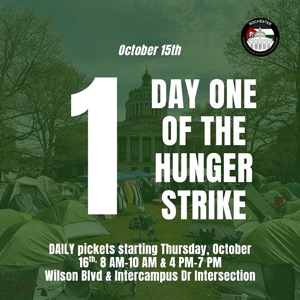
The SJP UR Instagram account announced that the hunger strikers would hold "daily pickets" in the morning and afternoon:
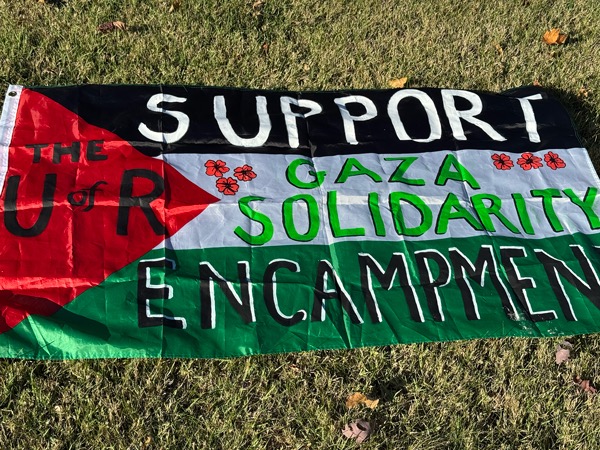
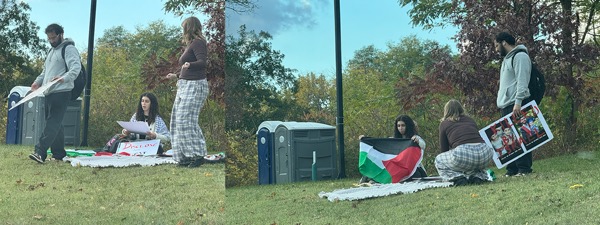
I couldn't resist, so I went to the afternoon picket session on the first day of the protest. I was expecting a fiery mob and thought I would have to watch and record it from afar, but instead I found just ten hapless looking protesters. I recognized their flag from the Spring 2024 "Gaza Solidarity" encampment at the university.
It was only the first day, so I overlooked the fact that none appeared underfed. Two of them took turns interviewing each other. One attempted unsuccessfully to fly a kite. Another tried to convince me that, with perseverance, SJP could force the university to "divest from the genocidal state of Israel."
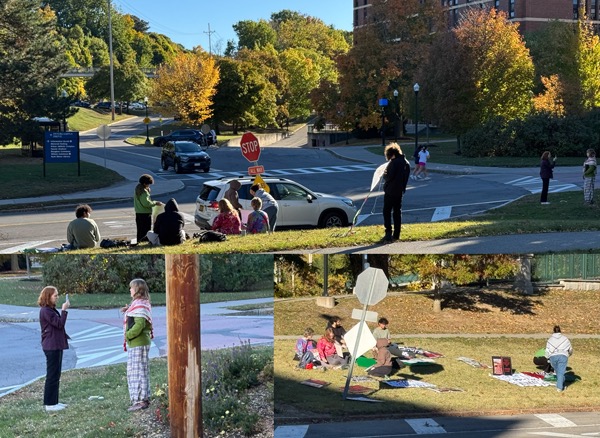
It was hard to believe that this was the same group that had sown chaos at the University of Rochester since October 7, and even brought that chaos to the Rochester Institute of Technology (where I teach) on November 13, 2023, but I recognized several of them.
By the third day, the protesters had cut back on their hours, eliminating the morning "pickets." Perhaps they interfered with breakfast.
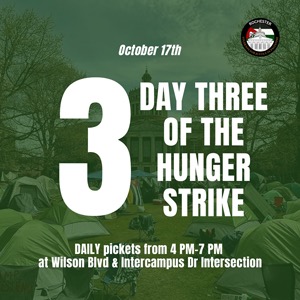
By the fourth day, they had cut the weekend "pickets." Apparently, every hunger artist needs a rest.
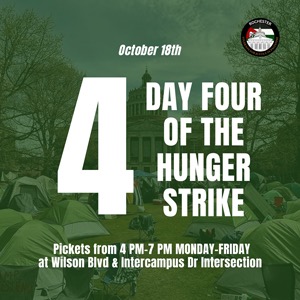
I took this to be good news, and when I went to observe on day 5, I found only three of the ten I had seen on the first day. The hunger strike was turning out to be a spectacular failure.
Then on the sixth day, the SJP UR Instagram account announced dramatically that the protest site was being moved "across from Wallis Hall," which is the main administration building where the president's office and all the top university officials' offices are located. It was intended to be an escalation, even though the new site was barely 100 yards from the original site.
On the seventh day, SJP UR posted a video (labeled Day 8) in which three members wrapped in keffiyehs stand in front of Wallis Hall spouting Hamas propaganda and issuing their demands that the university divest from Israel. National SJP immediately put the video on its Instagram page, amplifying SJP UR's message.
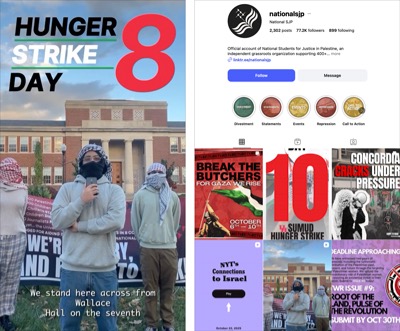
The next day, SJP UR announced that it was holding a Friday "rally" across from Wallis Hall. "MEET OUR DEMANDS," the message shouted.

I went to the Friday evening "rally" and found fewer than 20 protesters. They held signs decrying Benjamin Netanyahu as a war criminal and chanted "Globalize the Intifada." It was a far cry from the mob that set up an "encampment" on the lawn in front of the library in the Spring 2024 semester.
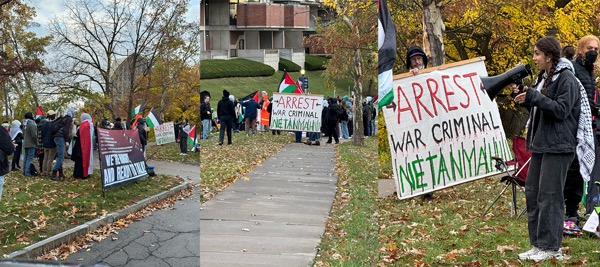
And then on Monday October 27, SJP UR abruptly announced that its hunger strike was over. The 7-page announcement, which includes a timeline from start to finish, is two parts melodrama, one part admonition.
"We endured hunger, emotional and physical exhaustion, and deteriorating health conditions – all while the university refused to meet with us, acknowledge our existence ... For 12 days we put our bodies on the line, willing to risk irreversible harm – including long-term neurological damage – just to be heard," the statement emotes. It continues, "We lost an average of 13 pounds per striker while experiencing progressively worsening symptoms, such as chest pains, heart palpitations, orthostatic hypotension, imbalance, and blurred vision."
The message ends with a warning: "We assure this university that we will never rest until the concerns of its Palestinian and anti-genocide students are acknowledged and addressed."
As they rest over the holiday break, SJP students at the University of Rochester and elsewhere are likely planning their next escapades for the Spring 2026 semester. If their slide into irrelevance continues at this rate, they'll probably hold their breath until their universities promise to meet their demands.
 Chief IPT Political Correspondent A.J. Caschetta is a principal lecturer at the Rochester Institute of Technology and a fellow at Campus Watch, a project of the Middle East Forum where he is also a Milstein fellow.
Copyright © 2025. Investigative Project on Terrorism. All rights reserved.
Articles by the IPT may be re-published as long as full attribution and a link back to the original article is provided. |
 JVP or SJP?
 Countering 'Pro-Palestine' Propaganda Part 2: Israel is a Settler-colonial State
 A Rajapaksa Plan for the Total Destruction of Hamas