





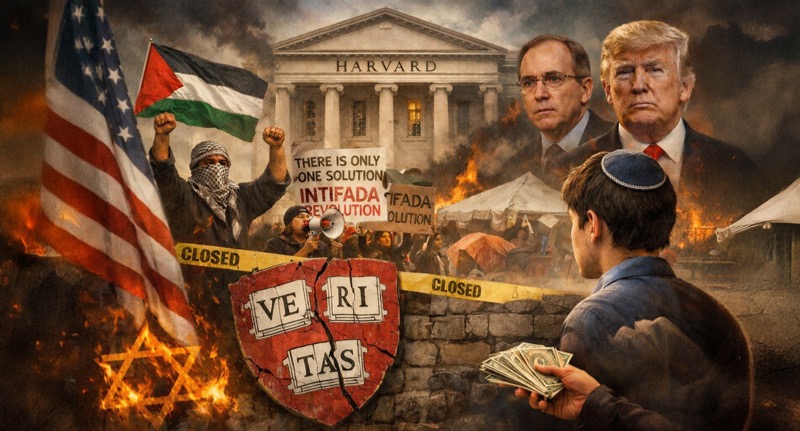
The Trump administration announced on March 20 that it is suing Harvard University for failing to curb its rampant antisemitism. In a 44-page complaint, the DOJ's Civil Rights Division lays out in painstaking detail how, after October 7, "Harvard fostered and continues to foster a campus climate where hostile antisemitism and anti-Israeli conduct thrives." Unfortunately, Harvard's "deliberate indifference" to its antisemitism problem began long before October 7, and it will take more than a lawsuit to correct the problem.
Trump's First Warning
On April 11, 2025 the Department of Health and Human Services, the Department of Education, and the General Services Administration sent a letter to Harvard President Alan Garber outlining a series of reforms the new administration was demanding in order to "maintain Harvard's financial relationship with the federal government." Among those demands, the letter calls for Harvard to "audit those programs and departments that most fuel antisemitic harassment or reflect ideological capture." This list includes the Center for Middle Eastern Studies (CMES), the Department of Near Eastern Languages and Cultures, and the Divinity School – Harvard's unholy Trinity of Jew Hatred.
In a section on "Student Discipline Reform and Accountability," the letter calls for Harvard to "end support and recognition of those student groups or clubs that engaged in anti-Semitic activity since October 7, 2023, including the Harvard Palestine Solidarity Committee, Harvard Graduate Students 4 Palestine, Law Students 4 Palestine, Students for Justice in Palestine" and others.
It also charges Harvard to adopt "a new policy on student groups or clubs that forbids the recognition and funding of, or provision of accommodations to, any student group or club that endorses or promotes criminal activity, illegal violence, or illegal harassment." Wisely recognizing that student clubs often invite incendiary speakers to campus and provide cover for banned and suspended student clubs, the letter stipulates that the new policy must prohibit clubs from "invit[ing] non-students onto campus who regularly violate campus rules or acts as a front for a student club that has been banned from campus."
The Criminal Complaint
While the April 2025 letter singles out Harvard's most egregious curators of antisemitism on campus, the new lawsuit accusing it of violating Title VI of the 1964 Civil Rights Act focuses on the administration's failure "to enforce its rules or meaningfully discipline the mobs that occupy its buildings and terrorize its Jewish and Israeli students."
It paints a picture of a university that sides with protesters, overlooks violations of policy, rewards bad behavior, and seeks to cover up its misdeeds.
A Police Chief Who Sided With the Protesters
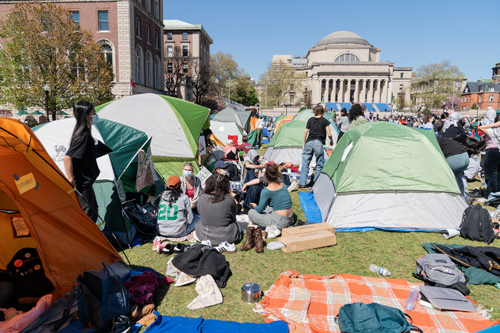
Since October 7, Harvard has repeatedly overlooked violations of policies by both students and faculty, including unauthorized protests and encampments. Some of these tactics were aimed at prohibiting students – especially Jewish students – from accessing buildings. Organizers described these events as "teach-ins," "sit-ins," "study-ins," and "die-ins." Harvard did nothing about them. In fact, Harvard University Police Chief Victor A. Clay actually sided with the protesters, "breaking the rules he was responsible for enforcing," according to the complaint. In an interview conducted on Friday April 27, 2024, (two days after Harvard students started their "Gaza encampment") Clay said, "we are keeping our students safe and they are protesting peacefully and it's their right and we are going to support that." As the Harvard Crimson staff writers correctly observed, "Clay's comments were the clearest indication yet that Harvard students face no imminent threat of being arrested."
The complaint argues that Harvard did nothing to stop protests that "featured outward hostility, harassment, and intimidation directed at Jewish and Israeli students." This includes chants of "from the river to the sea, Palestine will be free," "globalize the intifada," and the infamous Nazi-adjacent cry of "there is only one solution, intifada revolution." As the complaint puts it, the "only solution" rhetoric is "a call to expand violence towards Jews that reminds the listener of Nazi's 'final solution to the Jewish question,' which was the gas chambers."
Rewarding Antisemitic Conduct
Worse yet, it shows how the administration not only failed to discipline its protesters, but in some cases actually "rewarded students who assaulted, harassed, or intimidated their Jewish and Israeli peers."
For instance, when a group of students broke into and occupied University Hall on November 16, 2023, one Harvard dean "brought them burritos for dinner," while another dean brought them candy.
When a Jewish student named Yoav Segev attempted to video a "die-in" protest on October 18, 2023, two graduate students assaulted him and were criminally charged. Harvard later honored one of them, a law student named Ibrahim I. Bharmal, by naming him Class Marshal, gave him free housing, and awarded him a $65,000 fellowship to work at the Council on American-Islamic Relations as an "Immigrants' Rights Legal Fellow." Harvard president Alan Garber blamed Segev for his own assault, claiming that "the way he was taking videos appears provocative."
The Roots of Harvard's Problems
The criminal complaint does an impressive job of highlighting Harvard's antisemitic culture and the administration that abets it. However, it does not show how that culture was planted and nurtured, over the last two decades.
The Middle East Forum has documented decades of terrorist apologetics and antisemitism at the nation's most prestigious university. What the DoJ's complaint calls Harvard's "ideological capture" did not begin on October 7.
The First Warning Signs
One of the earliest critics to warn about Harvard's anti-Israel agenda was Hillel Stavis, owner of the famous WordsWorth book store in Cambridge, Massachusetts. Stavis began attending public lectures at Harvard in the 1990s and found that anti-Israel propaganda and groupthink had become commonplace at Harvard. He showed up at conferences and lectures and asked challenging questions that stood out from the usual obsequious audience participation at academic events. And he wrote about the events he attended.
He criticized Harvard's Project on Negotiation, documented its anti-Israel conferences, and called out the people who spoke at them, including peace-processor Dennis Ross. He wrote about a pro-Sharia speaker invited to lecture at Harvard's Divinity School, and a Harvard law professor who praised sharia. In 2011, he lambasted Harvard for commemorating the 10th anniversary of September 11 with an event devoted to the dangers of "Islamophobia."
And Harvard noticed.

Stavis once described to me how CMES event moderators, especially Sara Roy and Herbert C. Kelman, began to ignore him during the post-lecture Q&A sessions, growing increasingly hostile to his questions and presence. But Stavis pressed on, began filming the lectures and his questions.
Eventually, Roy implemented what critics of Middle East studies call "The Stavis Prohibition" by preventing audience members from recording CMES events and declaring that its events were "off the record."
Stavis died on October 20, 2023, but his legacy lives on at Harvard's CMES website where, to this very day, attendees of its events are warned that, "Unless otherwise noted in the event description, CMES events are open to the public (no registration required), and off the record." That this warning is still on the website a full year after the April 2025 letter to Alan Garber calling for Harvard "to ensure full transparency and cooperation with all federal regulators ... [n]o later than June 20, 2025," shows Harvard is not serious about transparency.
Conclusion
Harvard also seems unserious about changing its moribund, antisemitic culture. Change will take time and continued effort, like turning a battleship 180 degrees, and Garber hasn't even begun turning the wheel. He may not even know where the wheelhouse is. He told the Wall Street Journal that Harvard's problem was "the perceived lack of ideological diversity."
Harvard will almost certainly try to stall, pretend it's looking into the problem while waiting out the Trump administration and hoping for a president who will return to the status quo. Until then, Trump can inflict some pain over the next two and a half years, but a temporary loss of funding will not turn this battleship around.
Real change at Harvard will require two highly unlikely events. First, it would have to fire every Middle East studies specialist and every faculty member who has signed anti-Israel statements or made antisemitic social media posts. Second, it would require the impossible: their replacement with Middle East studies specialists and other academics who are not hostile to Israel. Unfortunately, they have been banished from academia.
Harvard's problem is not unique; in fact, Harvard's problem is academia's problem. The same thing is happening on nearly every college campus in the nation and in many other nations. Until that changes, "anti-Zionism" will remain the only acceptable form of discrimination and bias.
 Chief IPT Political Correspondent A.J. Caschetta is a principal lecturer at the Rochester Institute of Technology and a fellow at Campus Watch, a project of the Middle East Forum where he is also a Milstein fellow.
Copyright © 2026. Investigative Project on Terrorism. All rights reserved.
Articles by the IPT may be re-published as long as full attribution and a link back to the original article is provided. |
 Whitewashing Anti-Israel Campus Protests
 We've Seen This Before
 IPT Video: Peace Plan Protesters Echo Hamas Views of Israel