





Tehran's Outpost in Maida Vale
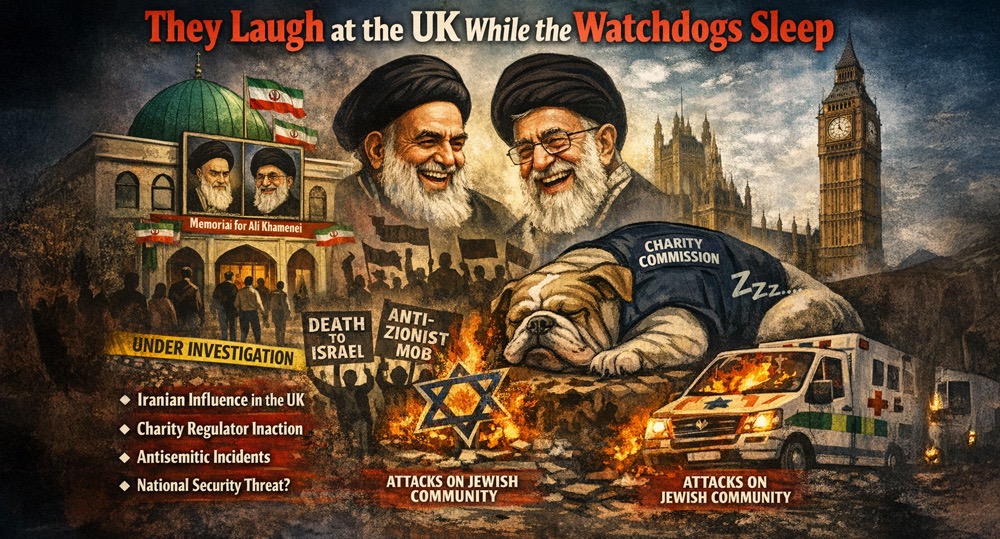
In the heart of Maida Vale, the Islamic Centre of England has, for years, operated as one of Tehran's most visible outposts in the UK. Critics have argued for years that it functions as more than a place of worship—serving instead as a platform for projecting Tehran's ideology, influence and recruitment abroad.
On 28 March this year, the Centre hosted a public memorial event for Iran's former Supreme Leader, Ali Khamenei, who was killed in an Israeli airstrike on 28 February.
Three Years of Regulatory Silence
Despite growing warnings from security agencies about Iran's hostile activities within the UK, successive governments have stopped short of taking decisive action, leaving such outlets largely untouched or worse supported them by paying them Covid furloughs and government grants.
In November 2022, the Charity Commission opened a formal inquiry into the Centre. The investigation was meant to examine concerns about governance, political activity, and potential links to the Iranian state.
More than three years on, the regulator has yet to publish its findings. There has not even been an update, and the centre continues with business as usual. The regulator also refuses to answer any questions by saying "because the centre is under investigation, they cannot comment"!
Business as Usual — and Then Some
This prolonged silence has raised serious questions while the Islamic Centre continues its extra curriculum activities:
During Ramadan last year, the Centre displayed daily messages from Iran's late Supreme Leader, Ali Khamenei, effectively relaying official state – a hostile state – messaging to a UK audience that included children and youngsters.
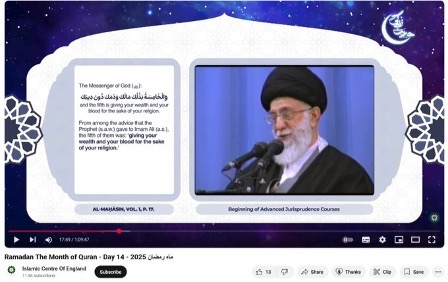
In the latest activity by the centre, which clearly breaks its charitable status, the Centre held a public remembrance event for the late Supreme Leader of Iran, Ali Khamenei.
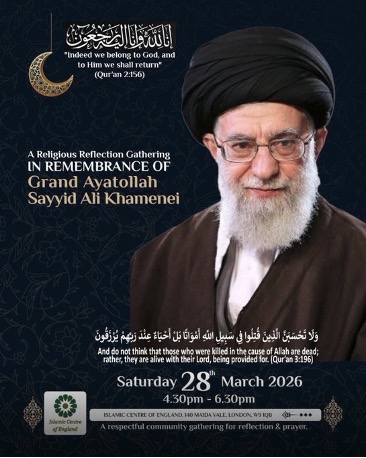
To remain within the UK charity law, organisers issued a disclaimer stating the event did not constitute "political endorsement":
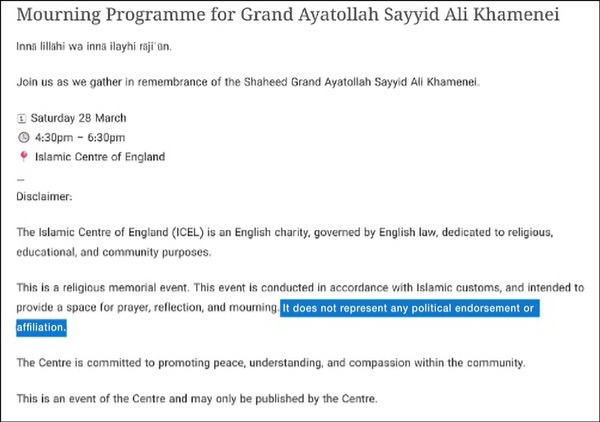
Such a statement stretches credibility beyond reasonable limits to say the least.
Commemorating the central figure of a theocratic state — one whose ideology underpins Iran's hostile political system—can hardly be viewed as "apolitical". The inclusion of prominent imagery of both Khomeini and Khamenei within the Centre, displayed for years, reinforces the perception that this is not merely religious observance, but political ideological alignment.
A National Security Question
The concerns extend beyond symbolism.
A recent report by Lord Walney—spanning over 100 pages—details what it describes as Iran's systematic exploitation of the UK charity sector. The report alleges that organisations linked to Tehran have been used to:
- Spread regime-aligned narratives
- Build influence networks
- Channel funding through opaque means
- Encourage agitation and division within communities
As Lord Walney, during the event that launched the report: "This is not merely a question of charity governance. It is a question of national security."
A Regulator Afraid of Its Own Shadow
The central issue remains the role of the Charity Commission.
Tasked with ensuring that charities operate within the law, the stated aims and in the public interest, the regulator has been criticised for being slow, reactive, and ineffective in dealing with political Islam in fear of being labelled Islamophobic.
The ongoing inquiry into the Islamic Centre of England has become, for some, a case study in regulatory inertia.
At a time when concerns over foreign influence, disinformation, and national security are rising, the absence of clear conclusions risks sending a troubling message: that enforcement is inconsistent, and that politically connected organisations may operate with little scrutiny. This is the message that the ruling Ayatollahs in Iran seem to have got, and they are laughing all the way at the UK.
The situation raises a broader issue for the UK:
Can a system designed to encourage civil society and religious freedom also guard against its exploitation by hostile foreign states?
Until the Charity Commission provides answers, that question remains unresolved.
And with each passing month of silence, confidence in the regulator tasked with upholding those standards continues to erode.
From Regulatory Failure to Violence on the Streets
It is also worth reminding that the UK Charity Commission is answerable to the UK parliament only. Many of the UK members of the parliament have been physically harassed and mobbed by pro-Palestine protesters. The former Conservative MP for Finchley and Golders Green and Justice Minister, Mike Freer, resigned in Feb 2024, over safety fears and the threats he received from Islamic extremists.
There is a very probable link between the blatant Iran related activities on the UK soil and the recent attacks on the Jewish community. Today the Counter Terrorism Police announced three more arrests were made in relation to an arson attack on volunteer-led ambulances run by the Jewish community in Golders Green which took place on 23rd March. Two British nationals and one dual British-Pakistani national have been arrested aged 20, 19 and 17 years old.
Two-Tier Policing and the Signal It Sends
Only a week later, in nearby Hendon, less than a mile away from where the Hatzalah ambulances were attacked, an angry mob of 40 individuals - calling themselves "anti-Zionist" - swept through a quiet Jewish residential area with no Israeli target in site, frightening the Jewish residents inside a retirement home with their loud chants through an amplifier. Police were called but they decided to let the "protest" to continue.
The local Labour MP for Hendon, David Pinto-Duschinsky said: "The so-called 'anti-Zionist' protesters chose to demonstrate at the heart of a quiet residential neighbourhood with a large Jewish community. It's utterly appalling, completely unacceptable and clearly antisemitic".
It is worth noting that the mob had no police permission. In the past the Metropolitan police had banned UK Independence Party (UKIP) - a lawful British political party - from marching in the Whitechapel area because of its large Muslim population.
The Metropolitan is often accused of 2-tier policing, such inconsistencies send a signal not just of weakness, but of permission—one that adversaries appear increasingly willing to exploit.
 IPT Senior Fellow Potkin Azarmehr is a London-based investigative journalist, business intelligence analyst, and TV documentary maker who was born in Iran. He regularly contributes to several newspapers and television stations on Iran and Middle East related news. You can follow him on Twitter @potkazar.
Copyright © 2026. Investigative Project on Terrorism. All rights reserved.
Articles by the IPT may be re-published as long as full attribution and a link back to the original article is provided. |