





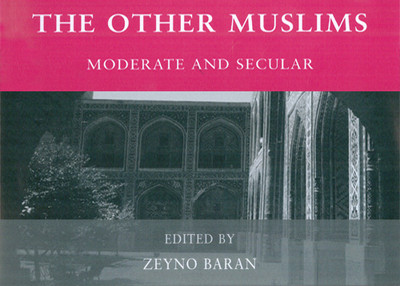
 The "most important ideological struggle in the world today is the battle over the future of Islam," writes Hudson Institute scholar Zeyno Baran.
Baran is the editor of an important new book, which goes on sale March 16, entitled "The Other Muslims: Moderate and Secular" - a compilation of personal analyses from 10 American and European Muslims who warn of the danger posed by radical Islamism.
The Islamist agenda includes a belief that Sharia (the legal code of the Quran ) reigns supreme over democracy and individual liberty. Islamists portray themselves as victims and demand special treatment for Muslims in the West.
The 2006 "Danish cartoon crisis" is an example cited by Baran. After riots broke out across the Muslim world following the publication of caricatures of the Prophet Mohamed, authors and playwrights withdrew their works from publication and persuaded publishers to reject submissions for fear of triggering more violence.
Multiple Islamist movements have been funded for decades by oil-rich nations like Saudi Arabia. One is the Wahhabists, Saudi radicals who seek to impose a form of Islam analogous to that practiced on the Arabian Peninsula 14 centuries ago. Another is the Egypt-based Muslim Brotherhood, whose members helped found the Council on American-Islamic Relations (CAIR), the Islamic Society of North America (ISNA), the Islamic Circle of North America (ICNA), the Muslim American Society (MAS), the Muslim Student Association (MSA) and the Muslim Public Affairs Council (MPAC) . (Another major group, prominent particularly in Europe and parts of Asia, is Hizb ut-Tahrir (HT), which seeks to establish a global caliphate.)
For several decades, Wahhabists and Muslim Brotherhood groups have been courted by Western governments and treated by the media as representatives of a near-monolithic "Muslim community."
But an alternate narrative has emerged in the Muslim world - one that rejects the Islamist worldview as anti-democratic. Baran, director of Hudson's Center for Eurasian Policy, minces no words in describing the danger.
"Islamism has much [in] common with totalitarian ideologies such as Nazism, Fascism, and Marxism-Leninism, including anti-Semitism, ethno-religious hatred, ambition to restructure the world, and an embrace of violence," she writes in the introduction to the book. "However, unlike purely political totalitarian movements, Islamism has a profound and deeper appeal that derives from its claim to stem from the will of God."
At a March 3 Hudson Institute forum launching The Other Muslims, Baran, Dr. Zuhdi Jasser, chairman of the American Islamic Forum for Democracy, and Hedieh Mirahmadi, an Iranian-American lawyer and activist, said that officials in Western democracies mistakenly try to promote nonviolent Islamist groups like the Muslim Brotherhood as "alternatives" to violent Islamists like Al Qaeda.
But the real differences between these organizations are tactical in nature. Both believe that Islam is superior to other religions and seek to impose sharia law in order to regulate virtually every aspect of life. "The West has lost sight of a fundamental truth: empowering Islamists, regardless of whether or not they are violent, sows the seeds for future radicalization that undermines our civilizational structures and breeds terrorism," Baran writes. "It is difficult to understand that 'nice people' who may even share an outwardly secular lifestyle still firmly believe that their lives should be governed according to a legal code of seventh-century Arabia."
The book's other contributors are Muslims from a wide variety of backgrounds who also oppose Islamists. Some are devoutly religious, while others are relatively secular. They are united in the belief that Islam is fully compatible with Western liberal democracy, and that Western governments should not be yielding to Islamist demands for the creation of "parallel societies," where they will be forced to live under Sharia.
How Islamists Work to Infiltrate the West
The authors provide concrete illustrations of the danger that Islamism poses to the West. In his chapter entitled "Americanism vs. Islamism," Jasser recalls being asked by his superiors at Bethesda Naval Hospital to present a paper at the Islamic Medical Association. The meeting in the early 1990s was held in conjunction with ISNA's national convention.
The keynote address was delivered by Imam Siraj Wahhaj, who said he was asked by a Jewish passenger sitting next to him on an airplane whether the Quran would replace the Constitution if Muslims became a majority in the United States. Wahhaj laughed and said: "Can you imagine someone wondering if a document made by humans would be superior to a document like the Quran, made by God?"
But Wahhaj's public suggestion that the Quran trumps the Constitution is more the exception than the rule. Wahhaj's comment (and others like it) could be very dangerous to the Islamist cause because it illustrates that the Islamists are not seeking equal protection of the law, but supremacy.
In the video below, Jasser recounts his public confrontation with Wahhaj.
As The Other Muslims makes clear, the Muslim Brotherhood has made inroads in the West by eschewing Wahhaj's approach in favor of softer tactics.
In the second chapter of the book, Yunis Qandil, currently a lecturer on Islamic studies at a Beirut think tank, provides a cogent analysis of the Brotherhood's successes in Europe. Qandil, a former Muslim Brotherhood activist, shows how the group has pushed aside moderate Muslims, monopolizing power and positioning itself as the "authentic" voice of the umma (the Muslim community) in numerous European countries.
Qandil, a native of Jordan whose parents were Palestinian refugees, writes that under the leadership of Sheikh Yusuf Qaradawi, the Brotherhood moved away from its formerly "isolationist" approach and now actively works to "infiltrate…their ideology into Western society and building their organizational infrastructure in the very heart of the West."
Since 9/ 11, he writes, the Brotherhood "has appointed itself chief mouthpiece for and coordinator of 'moderate Islam,'" utilizing rhetoric often found in the writings of leading figures such as Tariq Ramadan.
(Ramadan the grandson of Hassan al-Banna, founder of the Muslim Brotherhood - has denied being a member of the group. But like the Brotherhood, he also has a history of statements that appear to justify violence, including attacks on U.S. forces in Iraq, the killing of civilians in Israel and subway bombings in Great Britain. Ramadan has also made statements suggesting that he agrees with the Brotherhood's all- encompassing form of political Islam, for example, when refusing to condemn the stoning of adulterers.)
But despite its tactical flexibility and willingness to adapt to local conditions, an internal Brotherhood document reveals that the organization has a clear strategy that is hardly moderate. Qandil writes: "…first, win over the individual; second, ensure the spiritual education of the family, third, Islamize the society; and finally, seize power."
Unfortunately, as the book makes clear, Western democratic governments and politicians lack coherent strategies of their own to deal with the danger. Instead, they take a lowest-common-denominator approach - engaging with virtually any Muslim organization that is willing to "condemn terrorism," even if that organization ultimately seeks supremacy over non-Muslims. The strategy plays into the hands of Islamists who are prepared to use the rhetoric of nonviolence as a tactic to advance their political agenda.
But the news is not all bleak. The Other Muslims provides readers with numerous first-person accounts of how individuals triumphed over Islamist attempts to radicalize them.
In Chapter Five, Cosh Omar, a British actor and playwright of Turkish Cypriot descent, explains how he was recruited into Hizb ut-Tahrir, led by Omar Bakri Mohammad, in the 1990s. Cosh Omar later broke with HT when the group told him acting was a sin. He later realized that HT had tried to manipulate him in order to infiltrate Britain's Cypriot community through his father, a Sufi Muslim religious leader.
In Chapter Six, Samia Labidi, a French author, writes about growing up in Tunisia. Born in 1964, she was living a peaceful, happy childhood in an observant Muslim home until her sister married an Islamist who attempted to radicalize the family. Labidi's father adopted his son-in-law's oppressive views. But her mother refused. So she divorced her husband and moved to France.
Samia, left behind in Tunisia, was forced to wear a veil. She found herself trapped in the house and cut off from friends who refused to support an Islamic revolution in Tunisia. She moved to France in 1982 to join her mother, thinking she had left Islamism behind. But shortly after she got there, Islamists based in France (including her exiled brother-in-law) attempted to overthrow the Tunisian government. The coup failed, and many radicals fled to France and obtained "political refugee" status, creating new cadres for Islamism in Europe.
For more than a decade, Samia Labidi has been sounding the alarm about the danger posed by radical Islam in France, and to that end she founded an organization known as AIME, dedicated to fighting the spread of the Islamist ideology.
In Chapter Seven, Mostafa Hilali - a Moroccan immigrant to the Netherlands who serves as a major in the Netherlands Army - credits his parents' teachings about Islam for his ability to fend off radical recruiters. Hilali (who grew up just a few steps away from Mohammed Bouyeri, a second-generation Muslim immigrant who murdered Dutch filmmaker Theo Van Gogh) successfully withstood the mistreatment that can radicalize lesser men. This included a brutal beating by Dutch thugs who objected to his dating a Christian woman.
During his service in his nation's army, Hilali was involved in operations in Afghanistan, Iraq and Bosnia, where he helped his Dutch military colleagues better understand local Islamic cultures.
Some of the best material in the book appears in its final chapter, a must-read essay by Jasser. In it, he covers a tremendous amount of territory, including his childhood in Neenah, Wisconsin, where he was raised in a traditional Muslim home and imbued with a love of America and the freedoms Americans cherish.
Jasser makes a strong case that dictatorial Arab regimes in countries like Egypt, Syria and Saudi Arabia have close, albeit perverse, relationships with Islamist organizations. Egypt and Saudi Arabia, he writes, "are but two of the most malignant and metastatic examples of how a secular fascist dictator or an autocratic tribal monarchy can exploit a direct relationship with radical Islamist groups and institutions to keep the 'moderate' masses at bay."
"The dictators' love-hate relationship with radical Islam creates an environment where voices of reason are incapable of surviving amid this clash of evils," Jasser adds. That was particularly true, for example, when Syrian dictator Hafez Assad destroyed the town of Hama in 1982 (more than 30,000 Syrians were killed) in order to make an example of the Muslim Brotherhood.
There is much, much more food for thought in this very important, timely book.